Appendix D — Agentic AI in the field of Data Science - current capabilities and challenges
In this section, we explore the concept of Agentic Artificial Intelligence (Agentic AI), a recent development that has the potential to transform industries. We cover:
What is it and how does it differ from classical automation?
Give a practical example and show the differences to classical automation.
Discuss challenges and the question if it is a hype or if it is here to stay.
Before we define what Agentic AI is, let us have a look on its current relevance. The topic of Agentic AI is one of the main machine learning/artificial intelligence trends of 2025 and that is also roughly where the term was first introduced, as can be seen in the Google Trends chart below.
Figure D.1: Google Trends for related three search terms.
As we can see from Figure D.1, there is an increased interest in Agentic AI, compared to broader terms like artificial intelligence and machine learning. While Agentic AI is relatively new, we can see how it received more attention over time, indicating a wider use.
As usual in the machine learning world it is not completely new but a concept that can be traced back some time. The term agent-based process management system was already introduced in O’Brien and Wiesgand (1998) and the concepts presented there are not much different than our current definition. But what is the contemporary definition?
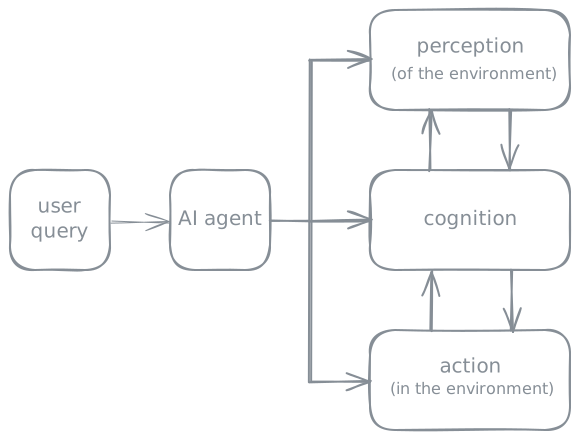
Definition D.1 (Agentic AI) The term Agentic AI refers to a class of artificial intelligence systems that operate autonomously, make decisions and perform tasks with minimal human intervention.
The key feature is the ability to proactively respond to changing conditions of the environment, produce fitted results or pursue specific goals. These systems can use reasoning, planning, and tools to complete a task. The way they solve a problem is not prescribed, but up to the AI.
In a sense, the AI has agency or freedom to act.
Figure D.2: Visualization of the basic architecture of an Agentic AI.
From Definition D.1 it is easy to understand why Agetic AI is gaining traction in industry. It increases the decision space in comparison to classical methods and allows for flexibility and adaptation to changing conditions. It has the potential to help transform industries with more automation by keeping track of ever-growing data and promising real-time action. Of course it also comes with limitations and challenges.
To get a better idea on all of these concepts, we look at an industry example that somewhat relates to machine learning in image processing but also features processing of time series.
D.1 Example application
Imagine a manufacturing plant that produces various products, where maintaining quality standards and meeting production schedules are critical. The product is assembled partially automated and partially by humans. We already have some image and signal processing in place to allow for quality control and we now look at how to introduce Agentic AI to this manufacturing plant to further automate tasks.
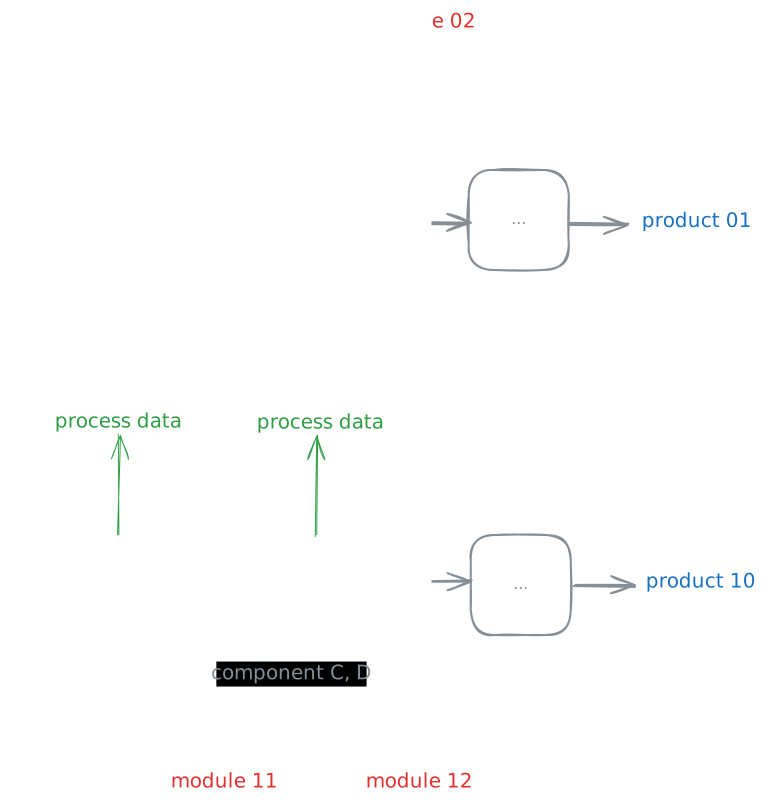
Figure D.3: Visualization of a manufacturing plant producing multiple products that consist of different parts and each part has multiple components.
In our little factory Figure D.3 there are a lot of possibilities to introduce Agentic AI.
Quality control and maintenance:
In manufacturing, ensuring product quality is critical. We no longer purely rely on manual inspection, we see automation and often with machine learning at hand. An Agentic AI system can integrate nicely into such a system by using the existing parts together with the process data to not only check for quality but also take action with regards to the results at hand. E.g. adjust process parameters, trigger a new learning phase for a machine learning model, inform about delays in the process (from in-house teams to the customer), decide where and how to rework, remove defect parts from the line (controlling a robotic arm), trigger the next stage of production, etc.
As the Agentic AI keeps track of the processes, it can also trigger maintenance, like ordering replacement parts.
The Agentic AI can track errors and with this knowledge adjust production processes to improve them.
Supply chain management:
If we fully connect the warehouse, an Agentic AI can trigger restocking of components. It can ask for a quote from different suppliers, decide according to price, delivery time, stock, (expected) orders, strategic diversification, etc.
Scheduling and resource optimization:
When new orders come in, the Agentic AI can create a schedule that best utilizes the resources, from the human work force, via part availability or electricity cost to the market prices.
If workers call in sick the Agentic AI can look for temporary workers.
Market adaptation:
Another Agentic AI could keep track of current trends and adjust products to follow trends (colour, material, …) and advertise the products.
Important
There is good reason that a lot of the above applications for Agentic AI are not implemented. If you only believe advertisement of AI companies the above list sounds great but we will see below that there are relevant concerns.
As the concept of Agentic AI seems to be so powerful, we should look under the hood and behind the hype and especially on the downsides and challenges.
D.2 Comparison to other methods
It is always a good idea to compare a new method or way of working to existing systems.
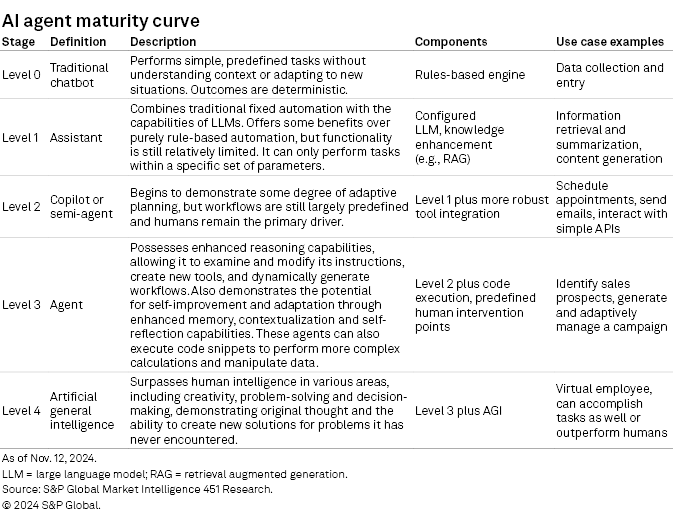
Before we compare it to existing solutions, let us have a look where Agentic AI systems are located on the artificial intelligence maturity curve.
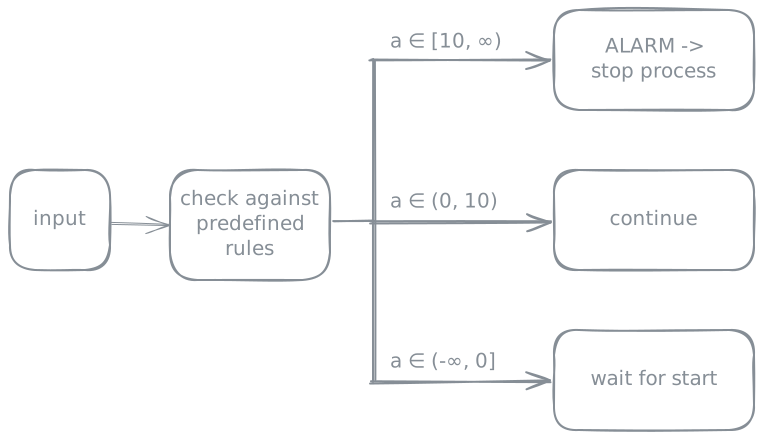
Figure D.5: Visualization of the basic architecture of classical automation.
Depending on the effort we put in, a lot of the above applications could be covered by a rule or fuzzy based automation system. The challenge for these systems is to cover all possible outcomes and react accordingly. Here, an Agentic AI promises much better adaptation. It could react to a situation that was not foreseen when setting up the system. On the other hand, maybe in such situations the system should stop the process and a human should investigate what caused this new situation.
Another argument is the ease of programming an Agentic AI. As input we can use natural language (because we all know that there is never any room for misinterpretation in language) and employ LLMs (Large Language Models) to contextualize the input together with the data to find an appropriate action. In low-code / no-code environments everybody, especially non-programmers and domain experts, can easily create such a system and the system itself knows how to use tools such as connecting to a database or a PROFIBUS1 interface of a milling machine. In this context, the Model Context Protocol (MCP)2 plays an important role to establish a standard. It should also be mentioned here, already classical automation tasks where often represented in low-code / no-code systems, so also this development is not completely new.
D.2.2 Retrieval-Augmented Generation - RAG
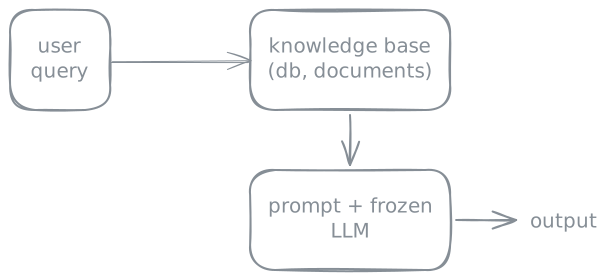
Figure D.6: Visualization of the basic RAG architecture.
In the context of automation Retrieval-Augmented Generation or RAG systems are often seen as the predecessors of Agentic AIs. RAG systems retrieve contextualized information from a knowledge base and generate responses based on the input. While RAG systems can suggest actions, they lack the ability to autonomously execute tasks, making them less powerful than Agentic AI. In some cases, RAG systems can complement Agentic AI by providing relevant data for decision-making.
D.3 Challenges
Of course Agentic AI also comes with a lot of challenges. Some will only surface over time, but some are already known from the start. We group the challenges to make them easier to understand.
D.3.1 Technical challenges
Unknown unknowns, the decision space is very open and it is impossible to account for all possibilities.
Explainability and trust for the system \(\to\) they can be a black box.
A lot of these systems rely on LLMs and they have multiple problems:
An LLM does not deliver reproducible results which is critical for automation.
LLMs might hallucinate a solution or follow a wrong path.
Language is not a precise tool to convey exact instructions, there is always room for interpretation, and common phrases or hidden assumptions, that differ from domain to domain (domain experts tend to forget to mention what is obvious).
Behaviour after an update of an LLM, or switch to another vendor, is not like a normal software update.
Bias in the training data and therefore the model.
Prompt injection might occur somewhere in the system.
The data quality and availability needs to be at a certain standard, otherwise the system will have problems.
D.3.2 Operational challenges
Integration with legacy systems.
Availability to process large quantities of data and the costs connected to such systems.
Maintainability of the system over the years.
Integration of innovative processes or tools from R&D that the AI does not know.
D.3.3 Regulatory and ethical challenges
Accountability - what if an action of the Agentic AI causes damages?
Data governance.
Production secrets.
Regulatory and compliance issues.
Hallucination or misinterpretation by LLMs.
Bias in the system.
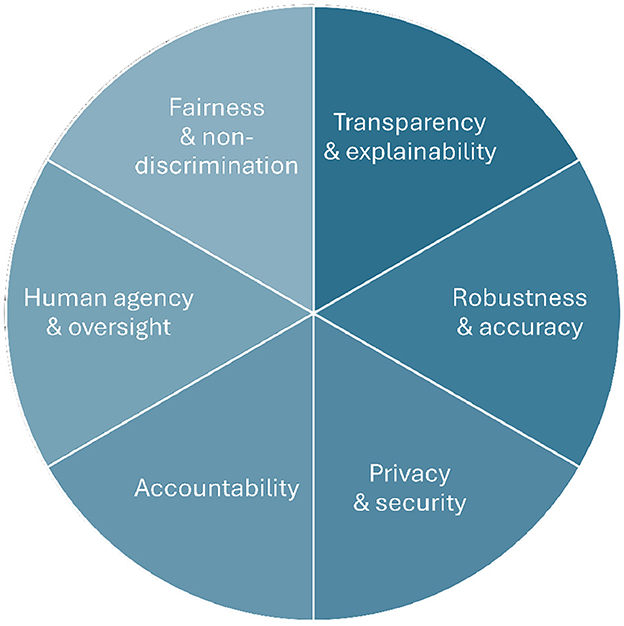
Trustworthy AI
These systems need to be accepted and in order to achieve this goal trustworthy AI is a key feature, even if it limits some features of Agentic AI systems.
[…] AI systems have yielded unexpected or undesirable outcomes or have been used in questionable manners. As a result, there has been a surge in public and academic discussions about aspects that AI systems must fulfill to be considered trustworthy.
Figure D.7: An illustration of the six requirements of trustworthy AI is investigated in Kowald et al. (2024). Click the image to view the original or use the direct link to the article (accessed 07.11.2025).
D.4 Popular tools (Winter 2025)
This field is developing rapidly and a list of popular tools is going to be outdated as soon as it is. Anyway, we should mention some tools:
Like so many other machine learning and artificial intelligence topics, the potential of Agentic AI is high, both in industry (Industry 4.0 or even 5.0?) and for personal use. It can boost automation, efficiency and adaptability. The challenges from technical limitations to ethical concerns are not solved and need to be better understood before such systems can work with little to no oversight.
Current research
Of course research is happening in this field. For example Otera (previously DeepOpinion) developed an approach to create trustworthy agents with the help of first-order logic and a solver to verify, e.g., insurance claims, see Peer and Stabinger (2025) or find slides to a talk of David Peer at the Engineering Kiosk Alps Meetup Innsbruck from 6th November 2025.
Kowald, Dominik, Sebastian Scher, Viktoria Pammer-Schindler, Peter Müllner, Kerstin Waxnegger, Lea Demelius, Angela Fessl, et al. 2024. “Establishing and Evaluating Trustworthy AI: Overview and Research Challenges.”Frontiers in Big Data Volume 7 - 2024. https://doi.org/10.3389/fdata.2024.1467222.
O’Brien, P. D., and M. E. Wiesgand. 1998. “Agent Based Process Management: Applying Intelligent Agents to Workflow.”The Knowledge Engineering Review 13 (2): 161–74. https://doi.org/10.1017/S0269888998002070.
Peer, David, and Sebastian Stabinger. 2025. “ATA: A Neuro-Symbolic Approach to Implement Autonomous and Trustworthy Agents.”https://arxiv.org/abs/2510.16381.
A standard for fieldbus communication in automation technology, see Wiki (accessed 07.11.2025).↩︎
For an introduction to this open source standard for connection to external systems follow the link (accessed 13.11.2025).↩︎