Appendix C — Writing a Neural Network from scratch
In this section we are going to write a small neural network from scratch. We use all of the information provided in the according part of this lecture, see Chapter 7 but we will give links where appropriate.
Important
This section is based on a similar introduction by Gregor Ehrensperger that he generously provided the authors as a basis.
A Jupyter notebook is available for a convenient implementation of the following parts. Download it here.
In the following codeblock we find our dependencies and we also fix the random number generation such that we fix the seed and therefore get reproducible results.
import numpy as npimport matplotlib.pyplot as pltimport sklearn.datasets as skdfrom sklearn.metrics import accuracy_scorefrom sklearn.model_selection import train_test_split
Code fragment for implementation.
def generate_dataset( setName: str, nrPoints: int, noise_factor: float=0, normalizeData: bool=True):""" Argument: setName -- name of set to be generated: blobs, circles, flower, moons, spiral1, spiral2, spiral3 nrPoints -- number of sample points noise_factor -- the higher, the more noise; set to 0 for no noise normalizeData -- transforms dataset such that mean is zero and standard deviation equals 1 Returns: X -- coordinates of the sampled points Y -- class of the sampled points """def generate_dataset_flower(nrPoints): N =int(nrPoints /2) X = np.zeros((2, nrPoints)) Y = np.zeros((1, nrPoints), dtype="uint8")for cat inrange(2): idx =range(N * cat, N * (cat +1)) theta = np.linspace(cat * np.pi, (cat +1) * np.pi, N) radius =4* np.sin(4* theta) X[0, idx] = radius * np.sin(theta) X[1, idx] = radius * np.cos(theta) Y[0, idx] = catreturn X, Ydef generate_archimedesSpiral(nrPoints, rounds):def archimedesSpiral(a, n): phi = np.linspace(2* np.pi, (rounds *2+2) * np.pi, n) X1 = [a * phi * np.cos(phi)] X2 = [a * phi * np.sin(phi)] X = np.vstack((X1, X2))return X N =int(nrPoints /2) firstSpiralX = archimedesSpiral(1.25* np.pi, N) secondSpiralX = archimedesSpiral(np.pi, N) X = np.hstack((firstSpiralX, secondSpiralX)) Y = np.ones((1, X.shape[1])) Y[:, : firstSpiralX.shape[1]] = np.zeros_like(firstSpiralX[0, :]) Y = Y.astype(int)return X, Ydef generate_blobs(nrPoints): X, Y = skd.make_blobs(n_samples=nrPoints, centers=2, n_features=2) X = X.T Y = Y[np.newaxis, :]return X, Ydef generate_circles(nrPoints): X, Y = skd.make_circles(n_samples=nrPoints) X = X.T Y = Y[np.newaxis, :]return X, Ydef generate_moons(nrPoints): X, Y = skd.make_moons(n_samples=nrPoints) X = X.T Y = Y[np.newaxis, :]return X, Yif setName =="flower": X, Y = generate_dataset_flower(nrPoints)elif setName =="spiral1": X, Y = generate_archimedesSpiral(nrPoints, 1)elif setName =="spiral2": X, Y = generate_archimedesSpiral(nrPoints, 1.5)elif setName =="spiral3": X, Y = generate_archimedesSpiral(nrPoints, 2)elif setName =="blobs": X, Y = generate_blobs(nrPoints)elif setName =="circles": X, Y = generate_circles(nrPoints)elif setName =="moons": X, Y = generate_moons(nrPoints)else:raiseException("Dataset "+ setName +" unknown")if normalizeData: X = (X - np.mean(X)) / np.std(X) X += np.random.randn(X.shape[0], X.shape[1]) * noise_factor * np.std(X)return X, Ydef plot_decision_boundary(model, X, Y):""" Argument: model -- prediction function X -- coordinates of sampled points Y -- class of sampled points """# Set min and max values and give it some padding x_min, x_max = X[0, :].min() -0.1, X[0, :].max() +0.1 y_min, y_max = X[1, :].min() -0.1, X[1, :].max() +0.1# Generate a grid of points with distance h between them xx, yy = np.meshgrid(np.linspace(x_min, x_max, 100), np.linspace(y_min, y_max, 100))# Predict the function value for the whole grid Z = model(np.c_[xx.ravel(), yy.ravel()]) Z = Z.reshape(xx.shape)# Plot the contour and training examples plt.contourf(xx, yy, Z, cmap=plt.cm.Spectral) plt.ylabel("x2") plt.xlabel("x1") plt.scatter(X[0, :], X[1, :], c=Y[0, :], cmap=plt.cm.Spectral) plt.show()
C.1 Weights and biases
Our first step in defining a neural network is to define the weights and biases that are required. For this example we implement a network with either three hidden layers.
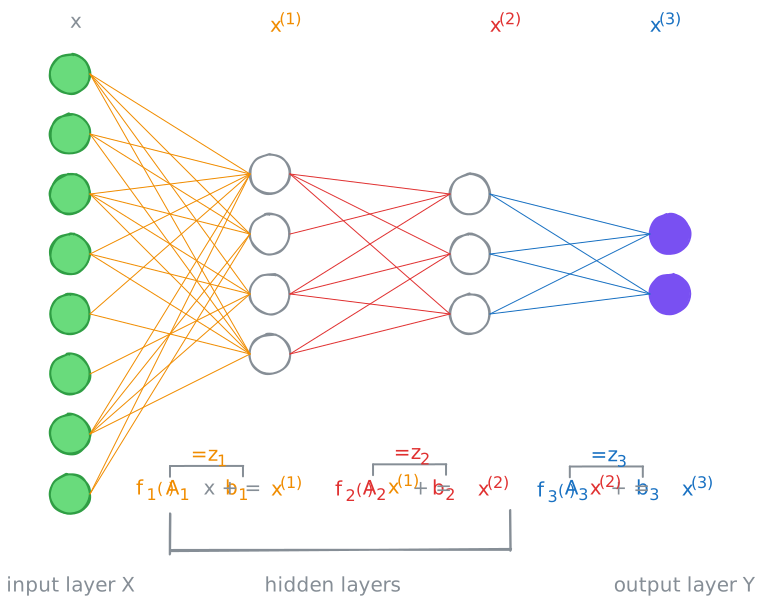
To help us in this progress we recall the basic structure for a generic neural network
Figure C.1: Generic NN with activation functions, weights and biases.
We denote the activation functions \(f_i\), weights \(A_i\), and biases \(b_i\), where \(i\) corresponds to the layer of the network. There are many different ways to initialize the weights and biases of a NN to achieve different properties. For this example we initialize the weights with random numbers from a normal distribution with \(\mu=0\) and \(\sigma=\tfrac{1}{\sqrt{n}}\) for \(n\) being the number of neurons from the previous step, i.e. in Figure C.1 for \(A_1\)\(n=8\) as \(x\) has \(8\) components. For the bias we initialize them with all zeros.
Exercise C.1 (Self implementation: Initialize the weights and biases) The following code snippet is incomplete, fill out the blanks to implement the correct functionality.
def initialize_weights(nodes0, nodes1, nodes2, nodes3):""" Argument: nodes0 -- size of the input layer nodes1 -- size of the first hidden layer nodes2 -- size of the second hidden layer nodes3 -- size of the output layer Returns: weights -- python dictionary containing weight and bias matrices """# initialize the weights and biases as numpy arrays# with the correct shapes.1 A1 = b1 = A2 = b2 = A3 = b3 =assert(A1.shape == (nodes1, nodes0))assert(b1.shape == (nodes1, 1))assert(A2.shape == (nodes2, nodes1))assert(b2.shape == (nodes2, 1))assert(A3.shape == (nodes3, nodes2))assert(b3.shape == (nodes3, 1)) weights = {"A1": A1,"b1": b1,"A2": A2,"b2": b2,"A3": A3,"b3": b3}return weights
1
Please fill in the blanks according to the above description.
Check the implementation of the weights and biases
Run the following code snippet to check the implementation.
np.random.seed(42) # Make sure to have a reproducible resultweights = initialize_weights(2, 8, 5, 1)result = np.array([np.mean(weights["A1"]), np.mean(weights["A2"]), np.mean(weights["A3"]), np.mean(weights["b1"]), np.mean(weights["b2"]), np.mean(weights["b3"])])reference = np.array([-0.0179896655582674, -0.0798199810455688,-0.0286928288067441, 0., 0., 0.])np.testing.assert_allclose(result, reference)print("Looks like your implementation for the weights is working :)")
C.2 Activation functions
Now that we have the weights and biases for our NN we need to define the activation functions. As there are multiple we will restrict ourself to the following:
linear \[f: x \mapsto x\]
sigmoid \[ f: x \mapsto \frac{1}{1 + \exp(-x)}\]
ReLU \[f: x \mapsto \begin{cases}
0 & \text{for}\quad x \leq 0,\\
x & \text{for}\quad x > 0.\\
\end{cases}\]
tanh \[f: x \mapsto \tanh(x)\]
Next to the function itself we will also need to implement the derivative. For each of these functions it is know how this looks like so we do not need to define it numerically.
def actFunctionLinear(x, derivative: bool=False):if derivative:returnelse:returndef actFunctionSigmoid(x, derivative: bool=False): if derivative:returnelse:returndef actFunctionRelu(x, derivative: bool=False): if derivative:returnelse:returndef actFunctionTanh(x, derivative: bool=False): if derivative:returnelse:return
Hint: If you visualize the functions you can compare the results to Figure 7.1.
C.3 Forward step
Now that we have the weights, biases, and the activation function we can define our forward step in the neural network. As a little help we recall the visualization:
Figure C.2: Generic NN with activation functions, weights and biases.
Exercise C.3 (Self implementation: Forward step)
def forward_propagation(X, weights, f1, f2, f3):""" Argument: X -- input data weights -- python dictionary containing the weight and bias matrices f1 -- python function as activation function layer 1 f2 -- python function as activation function layer 2 f3 -- python function as activation function layer 3 Returns: outputLayer -- The output of the last layer cache -- a dictionary containing (pre)activations of every layer """ A1 = weights["A1"] b1 = weights["b1"] A2 = weights["A2"] b2 = weights["b2"] A3 = weights["A3"] b3 = weights["b3"] x0 = X1 z1 = x1 = z2 = x2 = z3 = x3 = outputLayer = x3 cache = {"x0": x0,"z1": z1,"x1": x1,"z2": z2,"x2": x2,"z3": z3,"x3": x3}return outputLayer, cache
1
Please fill in the blanks according to the above description.
Hint: In numpy the matrix-matrix/matrix-vector multiplication is defined @.
Check the implementation for the forward step
Run the following code snippet to check the implementation, if there is no error the implementation looks good.
f1 = actFunctionLinear # function used for hidden layer 1f2 = actFunctionLinear # function used for hidden layer 2f3 = actFunctionSigmoid # function used for output layernp.random.seed(42) # Make sure to have a reproducible resultX, Y = generate_dataset("blobs", 1000, 0.5, False)np.random.seed(42) # Make sure to have a reproducible resultweights = initialize_weights(2, 8, 5, 1)outputLayer, cache = forward_propagation(X, weights, f1, f2, f3)result = np.array([np.mean(cache['x0']), np.mean(cache['z1']), np.mean(cache['x1']), np.mean(cache['z2']), np.mean(cache['x2']), np.mean(cache['z3']), np.mean(cache['x3'])])reference = np.array([3.3138498526746014, -0.22806136844696653,-0.22806136844696653, -1.5318738340852145,-1.5318738340852145, 1.1329044156610317, 0.7420574800205959])np.testing.assert_allclose(result, reference)print("Looks like the forward propagation is working :)")
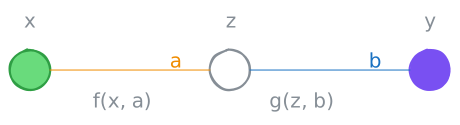
Example C.1 (A simple case) To illustrate the procedure we start with the simplest example, illustrated in Figure C.3.
Figure C.3: One node, one layer model for illustration of the backpropagation algorithm.
To get the output \(y\) from \(x\) the following computation is required \[
y = g(z, b) = g(f(x, a), b).
\]
If we now assume a means square error for the final loss, \[
\mathscr{L} = \frac12 (y_0 - y)^2,
\] we get an error, depending on the weights \(a\), \(b\), and for \(y_0\) being the ground truth or correct result. In order to minimize the error according to \(a\) and \(b\) we need to compute the partial derivatives with respect to these variables
For a particular \(\mathscr{L}\), \(g\), and \(f\) we can compute it explicitly, e.g. \(\mathscr{L}=\tfrac12(y_0 - y)^2\), \(g(z,b) = b z\), and \(f(x,a) = \tanh(a x)\)
With this information we can define the gradient descent update \[
\begin{aligned}
a^{(k+1)} &= a^{(k)} - \delta \frac{\partial\, \mathscr{L}}{\partial\, a} = a^{(k)} - \delta \left(- (y_0 - y) \cdot b^{(k)} \cdot (1 - \tanh^2(a^{(k)} x)) \cdot x\right), \\
b^{(k+1)} &= b^{(k)} - \delta \frac{\partial\, \mathscr{L}}{\partial\, b} = b^{(k)} - \delta \left( - (y_0 - y) \cdot \tanh(a^{(k)} x)\right).
\end{aligned}
\]
In the example we simplified but we can extend this to the general case with weight matrices and biases. Furthermore, the combination of the derivatives is an iterative process and we can reuse intermediate results for different parts, giving us some kind of recursion. Now, if we combine all theses findings we can compute the backpropagation as follows.
First, we define some helper variables with intermediate results. The symbol \(\odot\) denotes the point wise multiplication of matrices/vectors. Furthermore, we will train our network with multiple training values at the same time. To facilitate this, we need to dived the difference from our output and the labels by the negative number of samples, \(N\). \[
\begin{aligned}
\Delta^{(3)} &= \frac{Y - x^{(3)}}{-N} \\
\Delta^{(2)} &= \left(A_3^\mathsf{T} \cdot \Delta^{(3)}\right) \odot \partial f_2(z_2) \\
\Delta^{(1)} &= \left(A_2^\mathsf{T} \cdot \Delta^{(2)}\right) \odot \partial f_1(z_1) \\
\end{aligned}
\]
Next, we can define the derivatives of the weights. If we extend the formulas from Example C.1 to weight matrices and bias vectors some summation appears, this we can easily solve via matrix-vector multiplication.
For the weight we get \[
\begin{aligned}
\partial{A_3} &= \Delta^{(3)} \cdot \left(x^{(2)}\right)^\mathsf{T}, \\
\partial{A_2} &= \Delta^{(2)} \cdot \left(x^{(1)}\right)^\mathsf{T}, \\
\partial{A_1} &= \Delta^{(1)} \cdot \left(x^{(0)}\right)^\mathsf{T},
\end{aligned}
\]
and the biases
\[
\begin{aligned}
\partial{b_3} &= \Delta^{(3)} \cdot \mathbf{1}, \\
\partial{b_2} &= \Delta^{(2)} \cdot \mathbf{1}, \\
\partial{b_1} &= \Delta^{(1)} \cdot \mathbf{1}.
\end{aligned}
\] Where \(\mathbf{1}\) is the vector with all ones, i.e. \[
\mathbf{1} = \left(
\begin{array}{c}
1\\
1\\
\vdots\\
1
\end{array}
\right)\in \mathbb{R}^N.
\]
def backward_propagation(weights, cache, X, Y):""" Arguments: weights -- python dictionary containing our weights cache -- a dictionary containing "pA1", "A1", "pA2" and "A2". X -- input data of shape (2, number of examples) Y -- "true" labels vector of shape (1, number of examples) Returns: grads -- python dictionary containing your gradients with respect to different weights """ A1 = weights["A1"] A2 = weights["A2"] A3 = weights["A3"] b1 = weights["b1"] b2 = weights["b2"] b3 = weights["b3"] x0 = cache["x0"] x1 = cache["x1"] x2 = cache["x2"] x3 = cache["x3"] z1 = cache["z1"] z2 = cache["z2"] z3 = cache["z3"] N = X.shape[1]1 delta3 = delta2 = delta1 = dA3 = dA2 = dA1 = db3 = db2 = db1 = grads = {"dA1": dA1,"db1": db1,"dA2": dA2,"db2": db2,"dA3": dA3,"db3": db3}return grads
1
Please fill in the blanks according to the above description/formula.
Check the implementation for the backward step
Run the following code snippet to check the implementation, if there is no error the implementation looks good.
f1 = actFunctionLinear # function used for hidden layer 1f2 = actFunctionLinear # function used for hidden layer 2f3 = actFunctionSigmoid # function used for output layernp.random.seed(42) # Make sure to have a reproducible resultX, Y = generate_dataset("blobs", 1000, 0.5, False)np.random.seed(42) # Make sure to have a reproducible resultweights = initialize_weights(2, 8, 5, 1)outputLayer, cache = forward_propagation(X, weights, f1, f2, f3)grads = backward_propagation(weights, cache, X, Y)result = np.array([np.mean(grads["dA1"]), np.mean(grads["dA2"]), np.mean(grads["dA3"]), np.mean(grads["db1"]), np.mean(grads["db2"]), np.mean(grads["db3"])])reference = np.array([0.002965957830197586, 0.004537290504686634,0.14652013603577085, 0.0008235332844678776,-0.006945313835622825, 0.24205748002059585])np.testing.assert_allclose(result, reference)print("Looks like backward propagation is working :)")
C.5 Update parameters
Now that we have computed the differential of each of the parameters, we can use them to update the results. For this we recall the definition of the gradient descent method1 but we slightly adapt the notation to our purposes.
We express this algorithm in terms of the iterations \(\Theta_k\) for guesses of the minimum with the updates \[
\Theta_{k+1} = \Theta_{k} - \delta\, \partial f(\Theta_{k})
\] where the parameter \(\delta\) defines how far along the gradient descent curve we move, which we have so far called the learning rate. Here, \(\Theta\) corresponds to the different variables, so in our case this applies to each individual, i.e., \(A_i\) and \(b_i\).
Please fill in the blanks according to the above description/formula.
Check the implementation for the parameter update
Run the following code snippet to check the implementation, if there is no error the implementation looks good.
f1 = actFunctionLinear # function used for hidden layer 1f2 = actFunctionLinear # function used for hidden layer 2f3 = actFunctionSigmoid # function used for output layernp.random.seed(42) # Make sure to have a reproducible resultX, Y = generate_dataset("blobs", 1000, 0.5, True)np.random.seed(42) # Make sure to have a reproducible resultweights = initialize_weights(2, 8, 5, 1)outputLayer, cache = forward_propagation(X, weights, f1, f2, f3)grads = backward_propagation(weights, cache, X, Y)weights_upd = update_weights(weights, grads, learning_rate=0.05)result = np.array([np.mean(weights_upd["A1"]), np.mean(weights_upd["A2"]), np.mean(weights_upd["A3"]), np.mean(weights_upd["b1"]), np.mean(weights_upd["b2"]), np.mean(weights_upd["b3"])])reference = np.array([-0.01798925865224338, -0.07985076364711673,-0.034801399603810054, -2.269537873037303e-06,1.9140274093792395e-05, -0.0006670751853262199])np.testing.assert_allclose(result, reference)print("Looks like the weights are updated correctly :)")
To check the results, please run the following code snippet and if there is no error the implementation appears to be correct.
There is not much left to do but some parts are still missing.
def predict(weights, X, f1, f2, f3):""" Using the learned weights, predicts a class for each example in X Arguments: weights -- python dictionary containing your weights X -- input data of size (n_x, m) f1 -- python function as activation function layer 1 f2 -- python function as activation function layer 2 f3 -- python function as activation function layer 3 Returns predictions -- vector of predictions of our model (red: 0 / blue: 1) """1# 1. Computes probabilities using forward propagation,2# 2. and classifies to 0/1 using 0.5 as the threshold.return predictions
1
Computes probabilities using forward propagation,
2
and classifies to 0/1 using 0.5 as the threshold.
Check the implementation for the predict function
Run the following code snippet to check the implementation, if there is no error the implementation looks good.
f1 = actFunctionLinear # function used for hidden layer 1f2 = actFunctionLinear # function used for hidden layer 2f3 = actFunctionSigmoid # function used for output layernp.random.seed(42) # Make sure to have a reproducible resultX, Y = generate_dataset("blobs", 1000, 0.5, True)np.random.seed(42) # Make sure to have a reproducible resultweights = initialize_weights(2, 8, 5, 1)p = predict(weights, X, f1, f2, f3)np.testing.assert_allclose(np.sum(p), 645)print("Looks like your implementation is working, congratulations!")
C.7 Loss function
In order to figure out how close we are to our labels we need some kind of loss function. There are several possibilities, but we will stick to the logarithmic or cross entropy loss:
def compute_loss(nn_output, Y):# This function takes the nn_outputs and Ys of the training set# and returns the log lossreturn
Check the implementation for the loss function
Run the following code snippet to check the implementation, if there is no error the implementation looks good.
f1 = actFunctionLinear # function used for hidden layer 1f2 = actFunctionLinear # function used for hidden layer 2f3 = actFunctionSigmoid # function used for output layernp.random.seed(42) # Make sure to have a reproducible resultX, Y = generate_dataset("blobs", 1000, 0.5, True)np.random.seed(42) # Make sure to have a reproducible resultweights = initialize_weights(2, 8, 5, 1)outputLayer, cache = forward_propagation(X, weights, f1, f2, f3)result = compute_loss(outputLayer, Y)np.testing.assert_allclose(result, 0.7360633961687931)print("Looks like your implementation is working, congratulations!")
C.8 Implement the network training
Now we have all components together and we can implement the network training. For this we need to combine each step
def nn_model(X_train, Y_train, nodes0, nodes1, nodes2, nodes3, f1, f2, f3, lossfun, learning_rate, predict, num_iterations, print_cost=False, X_test=None, Y_test=None):""" Arguments: X_train -- training dataset of shape (2, number of examples) Y_train -- training labels of shape (1, number of examples) nodes_in -- size of the input layer nodes_h1 -- size of the first hidden layer nodes_h2 -- size of the second hidden layer nodes_out -- size of the input layer f1 -- activation function for the first layer f2 -- activation function for the second layer f3 -- activation function for the third layer num_iterations -- Number of iterations in gradient descent loop print_cost -- if True, print the cost every 1000 iterations X_test, Y_test -- test datasets; when set, accuracy is printed Returns: weights -- weights learnt by the model. They can then be used to predict. """# Use the previously coded function to generate the weights1 weights =# Loop (training with gradient descent)for i inrange(1, num_iterations +1):2# 2. forward propagation; the variable holding the network's# outputs should be called outputLayer3# 3. use the results to calculate the backward propagation4# 4. update the weights according to the results of the# backward propagation# Print the cost and accuracy every 500 iterationsif print_cost and i %500==0: accStr =''try: predictions = predict(weights, X_test, f1, f2, f3)if (X_test isnotNone) and (Y_test isnotNone ): accuracy = accuracy_score(predictions.flatten(), Y_test.flatten()) accStr ="(Acc: %f)"%(accuracy)except:pass# will be implemented later; no action loss = lossfun(outputLayer, Y_train)print("Cost after iteration %i: %f%s"%(i, loss, accStr))return weights
1
Use the previously coded function to generate the weights
2
Forward propagation; the variable holding the network’s outputs should be called outputLayer
3
use the results to calculate the backward propagation
4
update the weights according to the results of the backward propagation
Hint: All the parts that need to be implemented here are a one-liner with the help of the previously defined functions.
Check the implementation for the network training
Run the following code snippet to check the implementation, if there is no error the implementation looks good.
f1 = actFunctionLinear # function used for hidden layer 1f2 = actFunctionLinear # function used for hidden layer 2f3 = actFunctionSigmoid # function used for output layerloss_fun = compute_losspredict_fun = predictnp.random.seed(42) # Make sure to have a reproducible resultX, Y = generate_dataset("blobs", 1000, 0.4, False)np.random.seed(42) # Make sure to have a reproducible resultweights = nn_model(X, Y, 2, 5, 5, 1, f1, f2, f3, loss_fun, 0.05, predict_fun, 1000)result = np.array([np.mean(weights["A1"]), np.mean(weights["A2"]), np.mean(weights["A3"]), np.mean(weights["b1"]), np.mean(weights["b2"]), np.mean(weights["b3"])])reference = np.array([0.28620967900953265, -0.13481751949641932,-0.4163217207836666, 0.014763485056667431,-0.1323179529728214, 0.33857324167613034])np.testing.assert_allclose(result, reference)print("Looks like your implementation is working, congratulations!")
C.9 Our implementation in action
Now it is time to actually use and play around with our implementation of a NN. For this we provide some helper functions to make your life easier.
Reference implementation
In the following we present a reference implementation. This should only be used in case somebody is stuck in the implementation.
Code for initialization of the weights
def initialize_weights(nodes0, nodes1, nodes2, nodes3):""" Argument: nodes0 -- size of the input layer nodes1 -- size of the first hidden layer nodes2 -- size of the second hidden layer nodes3 -- size of the output layer Returns: weights -- python dictionary containing weight and bias matrices """# initialize the weights and biases as numpy arrays# with the correct shapes. A1 = np.random.normal(0, 1/ np.sqrt(nodes0), size=(nodes1, nodes0)) b1 = np.zeros((nodes1, 1)) A2 = np.random.normal(0, 1/ np.sqrt(nodes1), size=(nodes2, nodes1)) b2 = np.zeros((nodes2, 1)) A3 = np.random.normal(0, 1/ np.sqrt(nodes2), size=(nodes3, nodes2)) b3 = np.zeros((nodes3, 1))assert(A1.shape == (nodes1, nodes0))assert(b1.shape == (nodes1, 1))assert(A2.shape == (nodes2, nodes1))assert(b2.shape == (nodes2, 1))assert(A3.shape == (nodes3, nodes2))assert(b3.shape == (nodes3, 1)) weights = {"A1": A1,"b1": b1,"A2": A2,"b2": b2,"A3": A3,"b3": b3}return weightsnp.random.seed(42) # Make sure to have a reproducible resultweights = initialize_weights(2, 8, 5, 1)result = np.array([np.mean(weights["A1"]), np.mean(weights["A2"]), np.mean(weights["A3"]), np.mean(weights["b1"]), np.mean(weights["b2"]), np.mean(weights["b3"])])reference = np.array([-0.0179896655582674, -0.0798199810455688,-0.0286928288067441, 0., 0., 0.])np.testing.assert_allclose(result, reference)print("Looks like the weights are implemented correct :)")
def forward_propagation(X, weights, f1, f2, f3):""" Argument: X -- input data weights -- python dictionary containing the weight and bias matrices f1 -- python function as activation function layer 1 f2 -- python function as activation function layer 2 f3 -- python function as activation function layer 3 Returns: outputLayer -- The output of the last layer cache -- a dictionary containing (pre)activations of every layer """ A1 = weights["A1"] b1 = weights["b1"] A2 = weights["A2"] b2 = weights["b2"] A3 = weights["A3"] b3 = weights["b3"] x0 = X z1 = A1 @ x0 + b1 x1 = f1(z1) z2 = A2 @ x1 + b2 x2 = f2(z2) z3 = A3 @ x2 + b3 x3 = f3(z3) outputLayer = x3 cache = {"x0": x0,"z1": z1,"x1": x1,"z2": z2,"x2": x2,"z3": z3,"x3": x3}return outputLayer, cachef1 = actFunctionLinear # function used for hidden layer 1f2 = actFunctionLinear # function used for hidden layer 2f3 = actFunctionSigmoid # function used for output layernp.random.seed(42) # Make sure to have a reproducible resultX, Y = generate_dataset("blobs", 1000, 0.5, False)np.random.seed(42) # Make sure to have a reproducible resultweights = initialize_weights(2, 8, 5, 1)outputLayer, cache = forward_propagation(X, weights, f1, f2, f3)result = np.array([np.mean(cache['x0']), np.mean(cache['z1']), np.mean(cache['x1']), np.mean(cache['z2']), np.mean(cache['x2']), np.mean(cache['z3']), np.mean(cache['x3'])])reference = np.array([3.3138498526746014, -0.22806136844696653,-0.22806136844696653, -1.5318738340852145,-1.5318738340852145, 1.1329044156610317,0.7420574800205959])np.testing.assert_allclose(result, reference)print("Looks like the forward propagation is working :)")
Looks like the forward propagation is working :)
Code for definition of backward propagation
def backward_propagation(weights, cache, X, Y):""" Arguments: weights -- python dictionary containing our weights cache -- a dictionary containing "pA1", "A1", "pA2" and "A2". X -- input data of shape (2, number of examples) Y -- "true" labels vector of shape (1, number of examples) Returns: grads -- python dictionary containing your gradients with respect to different weights """ A1 = weights["A1"] A2 = weights["A2"] A3 = weights["A3"] b1 = weights["b1"] b2 = weights["b2"] b3 = weights["b3"] x0 = cache["x0"] x1 = cache["x1"] x2 = cache["x2"] x3 = cache["x3"] z1 = cache["z1"] z2 = cache["z2"] z3 = cache["z3"] N = X.shape[1] delta3 =-1/ N * (Y - x3) delta2 = (A3.T @ delta3) * f2(z2, True) delta1 = (A2.T @ delta2) * f1(z1, True) dA3 = delta3 @ x2.T dA2 = delta2 @ x1.T dA1 = delta1 @ x0.T db3 = delta3 @ np.ones_like(Y).T db2 = delta2 @ np.ones_like(Y).T db1 = delta1 @ np.ones_like(Y).T grads = {"dA1": dA1,"db1": db1,"dA2": dA2,"db2": db2,"dA3": dA3,"db3": db3}return gradsf1 = actFunctionLinear # function used for hidden layer 1f2 = actFunctionLinear # function used for hidden layer 2f3 = actFunctionSigmoid # function used for output layernp.random.seed(42) # Make sure to have a reproducible resultX, Y = generate_dataset("blobs", 1000, 0.5, False)np.random.seed(42) # Make sure to have a reproducible resultweights = initialize_weights(2, 8, 5, 1)outputLayer, cache = forward_propagation(X, weights, f1, f2, f3)grads = backward_propagation(weights, cache, X, Y)result = np.array([np.mean(grads["dA1"]), np.mean(grads["dA2"]), np.mean(grads["dA3"]), np.mean(grads["db1"]), np.mean(grads["db2"]), np.mean(grads["db3"])])reference = np.array([0.002965957830197586, 0.004537290504686634,0.14652013603577085, 0.0008235332844678776,-0.006945313835622825, 0.24205748002059585])np.testing.assert_allclose(result, reference)print("Looks like backward propagation is working :)")
Looks like backward propagation is working :)
Code for definition of updating the parameters
def update_weights(weights, grads, learning_rate):""" Arguments: weights -- python dictionary containing your weights grads -- python dictionary containing your gradients learning_rate Returns: weights -- python dictionary containing your updated weights """ A1 = weights["A1"] b1 = weights["b1"] A2 = weights["A2"] b2 = weights["b2"] A3 = weights["A3"] b3 = weights["b3"] dA1 = grads["dA1"] db1 = grads["db1"] dA2 = grads["dA2"] db2 = grads["db2"] dA3 = grads["dA3"] db3 = grads["db3"]# Update rule for each weight A1 = A1 - learning_rate * dA1 b1 = b1 - learning_rate * db1 A2 = A2 - learning_rate * dA2 b2 = b2 - learning_rate * db2 A3 = A3 - learning_rate * dA3 b3 = b3 - learning_rate * db3 weights["A1"] = A1 weights["b1"] = b1 weights["A2"] = A2 weights["b2"] = b2 weights["A3"] = A3 weights["b3"] = b3return weightsf1 = actFunctionLinear # function used for hidden layer 1f2 = actFunctionLinear # function used for hidden layer 2f3 = actFunctionSigmoid # function used for output layernp.random.seed(42) # Make sure to have a reproducible resultX, Y = generate_dataset("blobs", 1000, 0.5, True)np.random.seed(42) # Make sure to have a reproducible resultweights = initialize_weights(2, 8, 5, 1)outputLayer, cache = forward_propagation(X, weights, f1, f2, f3)grads = backward_propagation(weights, cache, X, Y)weights_upd = update_weights(weights, grads, learning_rate=0.05)result = np.array([np.mean(weights_upd["A1"]), np.mean(weights_upd["A2"]), np.mean(weights_upd["A3"]), np.mean(weights_upd["b1"]), np.mean(weights_upd["b2"]), np.mean(weights_upd["b3"])])reference = np.array([-0.01798925865224338, -0.07985076364711673,-0.034801399603810054, -2.269537873037303e-06,1.9140274093792395e-05, -0.0006670751853262199])np.testing.assert_allclose(result, reference)print("Looks like the weights are updated correctly :)")
Looks like the weights are updated correctly :)
Code for making a prediction
def predict(weights, X, f1, f2, f3):""" Using the learned weights, predicts a class for each example in X Arguments: weights -- python dictionary containing your weights X -- input data of size (n_x, m) f1 -- python function as activation function layer 1 f2 -- python function as activation function layer 2 f3 -- python function as activation function layer 3 Returns predictions -- vector of predictions of our model (red: 0 / blue: 1) """# Computes probabilities using forward propagation, # and classifies to 0/1 using 0.5 as the threshold. outputLayer, _ = forward_propagation(X, weights, f1, f2, f3) predictions = (outputLayer >0.5).astype(int)return predictionsf1 = actFunctionLinear # function used for hidden layer 1f2 = actFunctionLinear # function used for hidden layer 2f3 = actFunctionSigmoid # function used for output layernp.random.seed(42) # Make sure to have a reproducible resultX, Y = generate_dataset("blobs", 1000, 0.5, True)np.random.seed(42) # Make sure to have a reproducible resultweights = initialize_weights(2, 8, 5, 1)p = predict(weights, X, f1, f2, f3)np.testing.assert_allclose(np.sum(p), 645)print("Looks like prediction is working :)")
Looks like prediction is working :)
Code for making a loss function
def compute_loss(nn_output, Y):# This function takes the nn_outputs and Ys of the training set# and returns the log loss N = Y.shape[1]return (-1/ N) * np.sum(Y * np.log(nn_output) + (1- Y) * np.log(1- nn_output))f1 = actFunctionLinear # function used for hidden layer 1f2 = actFunctionLinear # function used for hidden layer 2f3 = actFunctionSigmoid # function used for output layernp.random.seed(42) # Make sure to have a reproducible resultX, Y = generate_dataset("blobs", 1000, 0.5, True)np.random.seed(42) # Make sure to have a reproducible resultweights = initialize_weights(2, 8, 5, 1)outputLayer, cache = forward_propagation(X, weights, f1, f2, f3)result = compute_loss(outputLayer, Y)np.testing.assert_allclose(result, 0.7360633961687931)print("Looks like the loss function is working!")
Looks like the loss function is working!
Code for doing the network training
def nn_model(X_train, Y_train, nodes0, nodes1, nodes2, nodes3, f1, f2, f3, lossfun, learning_rate, predict, num_iterations, print_cost=False, X_test=None, Y_test=None):""" Arguments: X_train -- training dataset of shape (2, number of examples) Y_train -- training labels of shape (1, number of examples) nodes_in -- size of the input layer nodes_h1 -- size of the first hidden layer nodes_h2 -- size of the second hidden layer nodes_out -- size of the input layer f1 -- activation function for the first layer f2 -- activation function for the second layer f3 -- activation function for the third layer num_iterations -- Number of iterations in gradient descent loop print_cost -- if True, print the cost every 1000 iterations X_test, Y_test -- test datasets; when set, accuracy is printed Returns: weights -- weights learnt by the model. They can then be used to predict. """# Use the previously coded function to generate the weights weights = initialize_weights(nodes0, nodes1, nodes2, nodes3)# Loop (training with gradient descent)for i inrange(1, num_iterations +1):# 2. forward propagation; the variable holding the network's# outputs should be called outputLayer# 3. use the results to calculate the backward propagation# 4. update the weights according to the results of the# backward propagation outputLayer, cache = forward_propagation(X_train, weights, f1, f2, f3) grads = backward_propagation(weights, cache, X_train, Y_train) weights = update_weights(weights, grads, learning_rate)# Print the cost and accuracy every 500 iterationsif print_cost and i %500==0: accStr =''try: predictions = predict(weights, X_test, f1, f2, f3)if (X_test isnotNone) and (Y_test isnotNone ): accuracy = accuracy_score(predictions.flatten(), Y_test.flatten()) accStr ="(Acc: %f)"%(accuracy)except:pass# will be implemented later; no action loss = lossfun(outputLayer, Y_train)print("Cost after iteration %i: %f%s"%(i, loss, accStr))return weightsf1 = actFunctionLinear # function used for hidden layer 1f2 = actFunctionLinear # function used for hidden layer 2f3 = actFunctionSigmoid # function used for output layerloss_fun = compute_losspredict_fun = predictnp.random.seed(42) # Make sure to have a reproducible resultX, Y = generate_dataset("blobs", 1000, 0.4, False)np.random.seed(42) # Make sure to have a reproducible resultweights = nn_model(X, Y, 2, 5, 5, 1, f1, f2, f3, loss_fun, 0.05, predict_fun, 1000)result = np.array([np.mean(weights["A1"]), np.mean(weights["A2"]), np.mean(weights["A3"]), np.mean(weights["b1"]), np.mean(weights["b2"]), np.mean(weights["b3"])])reference = np.array([0.28620967900953265, -0.13481751949641932,-0.4163217207836666, 0.014763485056667431,-0.1323179529728214, 0.33857324167613034])np.testing.assert_allclose(result, reference)print("Looks like the network training is working :)")
Looks like the network training is working :)
First we define some training settings.
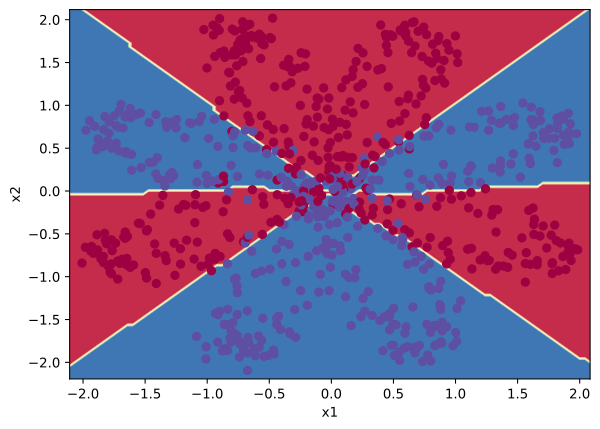
datasetName ='flower'# see function generateDataset()nrSamplePoints =1000noise_factor =0.1normalize_data =True# neural network architecture optionsf1 = actFunctionReluf2 = actFunctionRelu# learning optionslearning_rate =0.1nrIterations =10000
The next part is not to be modified. We define the required functions and the dataset.
# do not change the following settingsf3 = actFunctionSigmoidnodes0 =2# nr of nodes of the input layernodes3 =1# nr of nodes of the output layernp.random.seed(42) # Make sure to have a reproducible resultX, y = generate_dataset(datasetName, nrSamplePoints, noise_factor, normalize_data)X_train, X_test, y_train, y_test = train_test_split(X.T, y.T, test_size=0.2, random_state=42)X_train = X_train.TX_test = X_test.Ty_train = y_train.Ty_test = y_test.T
Now, we have liberty in the dimension of the hidden nodes.
nodes1 =15nodes2 =10np.random.seed(42) # Make sure to have a reproducible resultweights = nn_model(X_train, y_train, nodes0, nodes1, nodes2, nodes3, f1, f2, f3, loss_fun, learning_rate, predict_fun, nrIterations, True, X_test, y_test)predictions = predict(weights, X_test, f1, f2, f3)accuracy = accuracy_score(predictions.flatten(), y_test.flatten())
Cost after iteration 500: 0.240941 (Acc: 0.895000)
Cost after iteration 1000: 0.184200 (Acc: 0.895000)
Cost after iteration 1500: 0.176449 (Acc: 0.895000)
Cost after iteration 2000: 0.172863 (Acc: 0.880000)
Cost after iteration 2500: 0.171350 (Acc: 0.880000)
Cost after iteration 3000: 0.170436 (Acc: 0.880000)
Cost after iteration 3500: 0.169528 (Acc: 0.875000)
Cost after iteration 4000: 0.168499 (Acc: 0.875000)
Cost after iteration 4500: 0.167735 (Acc: 0.880000)
Cost after iteration 5000: 0.166953 (Acc: 0.880000)
Cost after iteration 5500: 0.166196 (Acc: 0.880000)
Cost after iteration 6000: 0.165612 (Acc: 0.880000)
Cost after iteration 6500: 0.164950 (Acc: 0.880000)
Cost after iteration 7000: 0.164483 (Acc: 0.880000)
Cost after iteration 7500: 0.164081 (Acc: 0.880000)
Cost after iteration 8000: 0.163701 (Acc: 0.880000)
Cost after iteration 8500: 0.163341 (Acc: 0.880000)
Cost after iteration 9000: 0.162991 (Acc: 0.880000)
Cost after iteration 9500: 0.162671 (Acc: 0.880000)
Cost after iteration 10000: 0.162360 (Acc: 0.870000)